cw.wishnode.net
Upload a .wav or .mp4 — up to 50 MB and 10 minutes — and get back an artist's rendition of it: a hand-drawn film that reads your audio's ideas first — the word cloud before any drawing — then forms it sentence by sentence below, ideas combining upward as liquid sand settles on what forms, and deposits each beat above as a tile on a growing map. The map is a phext, and you get both: the film (24 fps) and the phext itself.
Example — an artist's rendition of this audio
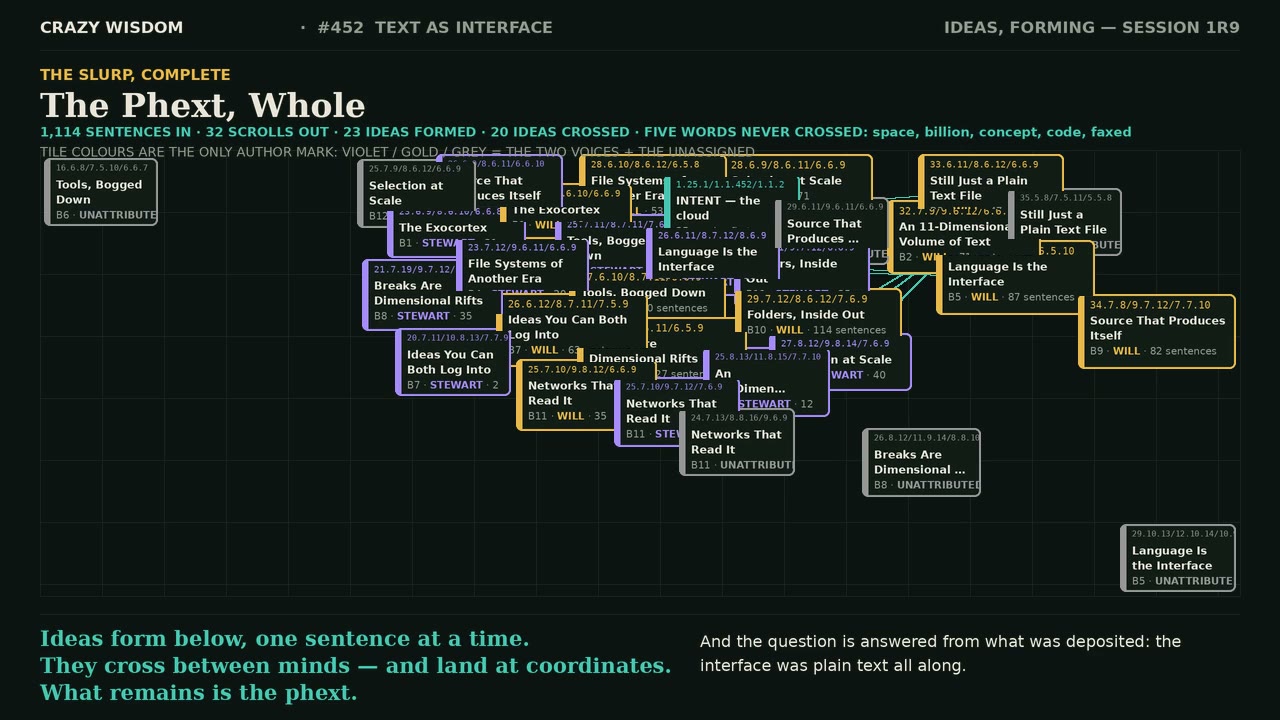
Crazy Wisdom #452, “Text as Interface” — Will Bickford's first appearance on the show, 55 minutes of audio. The film below is Session 1R9 — the current process itself, drawn over the episode's 1,114 sentences: below, the ideas form first (23 formed, 20 crossing between the two voices, liquid sand settling on each); above, the conversation's 12 beats land as 31 tiles on the closing map. Rendered at 60 fps, delivered at exactly 24 fps. Uploads today are drawn by the service engine, a generalisation of this very renderer.
Prefer the file? Download the rendition (mp4, 120 MB)
Download the example's phext — the rendition itself as text: 32 scrolls — an index at the episode's coordinate, the intent cloud, and one scroll per beat and voice at its multiversal coordinate, carrying all 1,114 sentences verbatim.
Ready to draw:
Fine-tune the drawing hand
Every slider is a real parameter of the method — the defaults are the reference rendition's own settings. Describe the drawing in words, or move the sliders; either way you see exactly what will be used, and the finished job records its parameters so the style can be reproduced and shared.
The word mapping is a small fixed vocabulary — no model, no hidden call: . Anything unrecognized is reported, never guessed at.
Transcription runs on our own machines — whisper.cpp on the ranch (a Mac mini helps when it's awake), never a cloud API. The voices are separated spectrally, and carried as colours only.
Before any drawing, the whole stream is read for its ideas: a word cloud weighted by holographic centrality, recurrence and topic mass.
Below, sentences arrive at their holographic positions and ideas that meet combine upward into layered notes — liquid sand settling on every formation and every crossing between voices.
Above, each beat lands as a tile at its coordinate — the map is a phext being written. Rendered at 60 fps, blended down to exactly 24 fps; held text never moves.
The method is the Crazy Wisdom doodle practice's validated process (Sessions 1R5–1R9: intent first, two views, ideas as the protagonists). The example above is Session 1R9 itself, on episode #452 — watch the finished film. Uploads are drawn by the service engine, a generalisation of the current session's renderer, and return the same two deliverables: the film at 24 fps, and the rendition itself as a .phext — an index at the home coordinate, the intent scroll, and one scroll per beat and voice at its multiversal coordinate, carrying every sentence verbatim, with the attribution evidence and the job's drawing style stamped in.